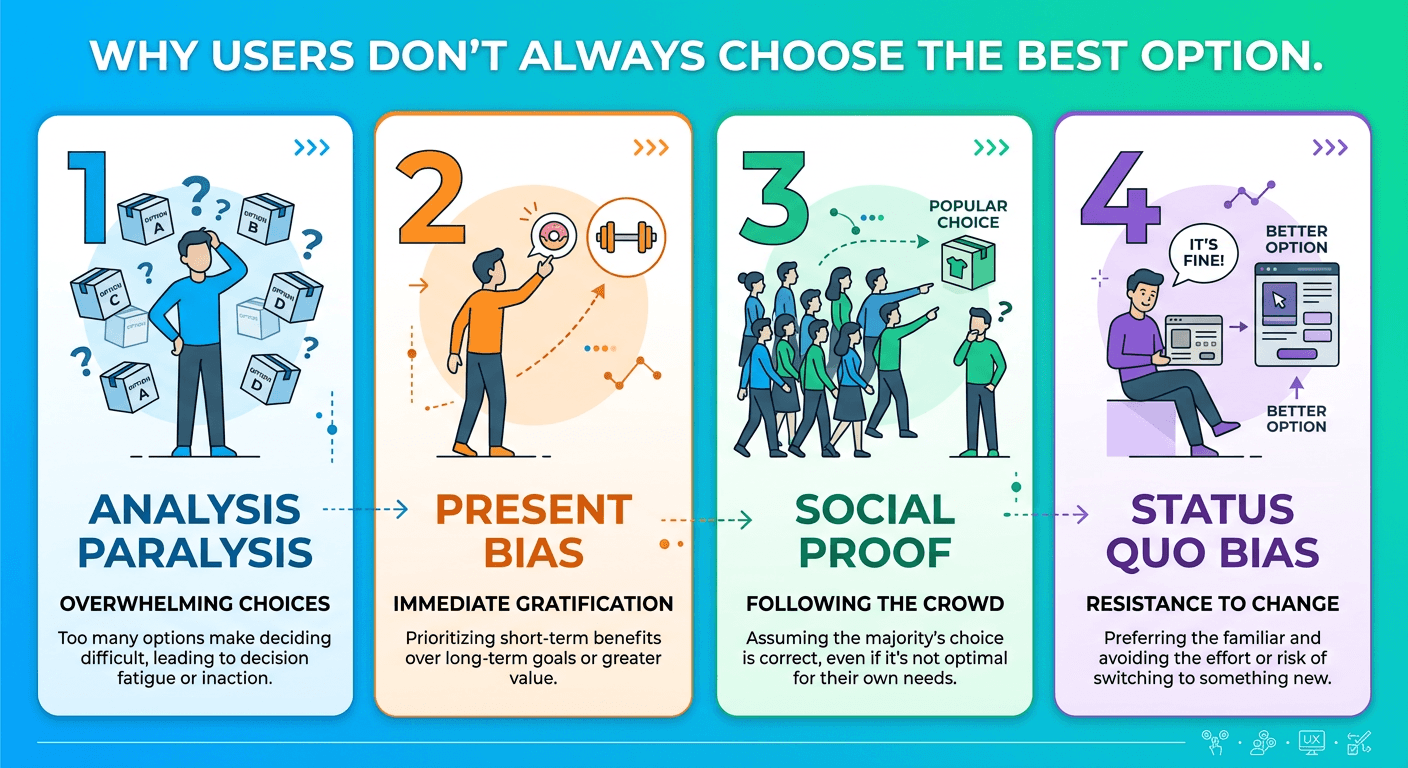
Why Users Don’t Always Choose the Best Option
Most businesses assume users will choose the best option.
The most value. The most features. The most logical choice.
But that’s not how decisions actually work.
People Choose What Feels Right
Decisions aren’t purely logical.
They’re emotional first.
Then justified with logic.
Before someone compares features or pricing, they’re asking:
Does this feel right? Does this feel safe? Does this feel clear?
If the answer is no, they don’t move forward.
Perception Shapes the Decision
Two options can be objectively similar.
But if one feels easier to understand or more trustworthy, it wins.
Not because it’s better.
Because it feels better.
This Is Where Anchoring Comes In
The first thing someone sees sets the frame.
The first price. The first plan. The first impression.
Everything else gets compared against it.
This is exactly what’s happening in The Anchoring Effect: Why the First Price Your Customer Sees Matters.
The “Best” Option Still Needs to Feel Right
Even if you structure your pricing perfectly, it won’t convert if it doesn’t feel intuitive.
Users need:
Clear differences Clear positioning Clear guidance
Without that, they hesitate.
This Is Why “Most Popular” Works
Highlighting one option reduces effort.
It signals:
“This is what most people choose.”
That removes uncertainty.
(Connected to: The Psychology of “Most Popular” Pricing Plans)
Decision-Making Is About Reducing Effort
The easier a choice feels, the more likely someone is to make it.
Not because it’s the best.
Because it’s the easiest to process.
Make the Right Option Feel Obvious
You don’t need to force decisions.
You need to guide them.
When the right choice feels natural, users take it.