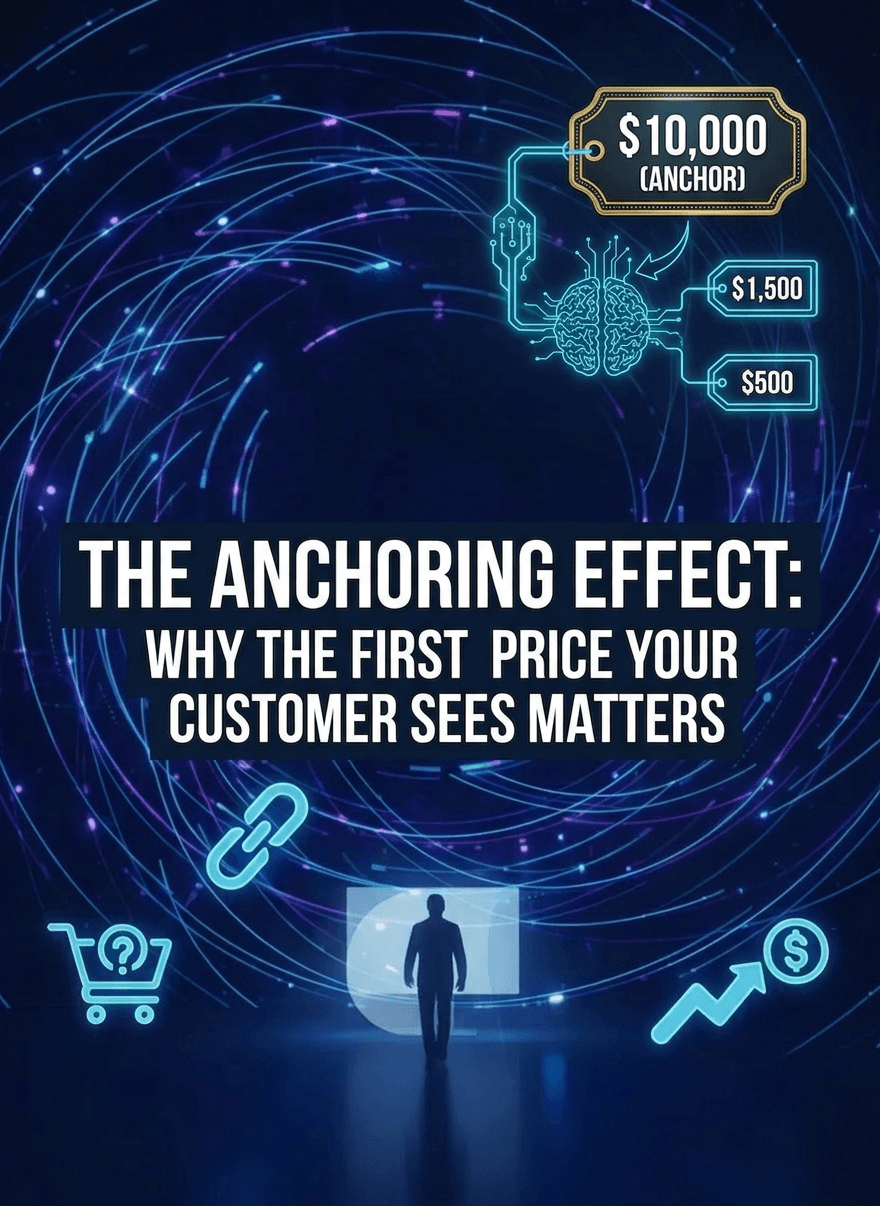
The Anchoring Effect: Why the First Price Your Customer Sees Matters
Pricing is rarely judged in isolation.
Instead, people evaluate prices relative to what they saw before.
This is known as the anchoring effect, and it plays a powerful role in how customers interpret pricing.
The first number a visitor sees often becomes the reference point for everything that follows.
Anchors Shape Perception
Imagine seeing two prices:
$1,200 $300
If you saw the $1,200 option first, the $300 price suddenly feels affordable.
But if the first number you see is $300, the same price may feel expensive.
The anchor changes how people interpret value.
Pricing Pages Use Anchors Strategically
High-converting pricing pages often place a higher-priced plan first.
This creates a reference point that makes other options feel more reasonable.
The goal isn’t to trick customers.
It’s to provide context that helps them evaluate the value of each option.
These decisions are explored more deeply in Pricing Page Psychology: Where Conversions Are Won or Lost.
Anchors Also Influence Tier Structure
Anchoring is especially important when designing pricing tiers.
When tiers are structured correctly, customers can quickly compare options and identify which plan feels right.
But when pricing tiers lack clear structure, visitors struggle to interpret the value of each option.
This is one reason why some pricing pages fail to convert effectively, as explained in Why Most Pricing Tiers Fail to Convert.
Pricing Is a Psychological Experience
Customers don’t evaluate pricing purely through logic.
Perception, comparison, and context all influence how prices feel.
Understanding these psychological dynamics allows businesses to structure pricing pages that guide customers toward confident decisions.