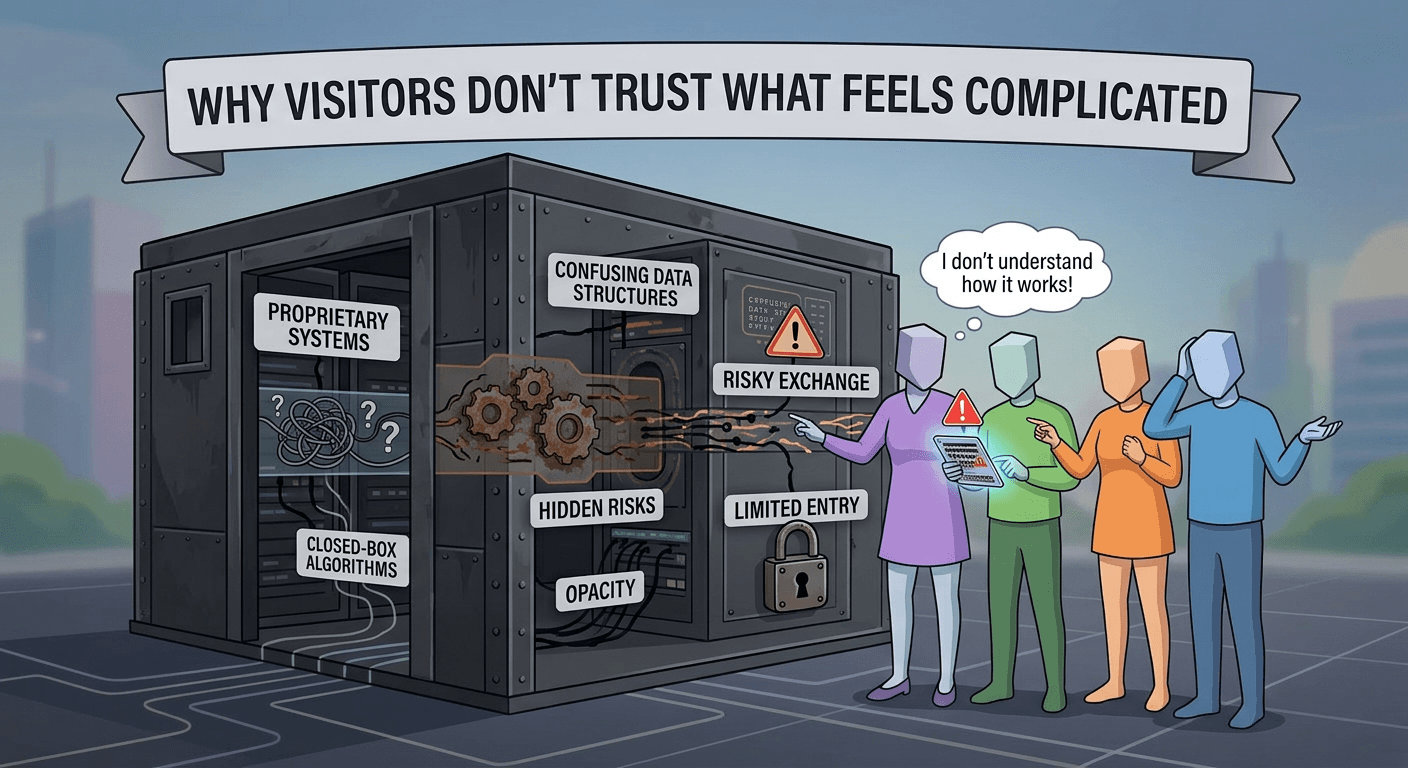
Why Visitors Don’t Trust What Feels Complicated
Complexity doesn’t just confuse people.
It makes them hesitate.
And hesitation is where trust starts to break.
Complicated Feels Like Risk
When something is hard to understand, people don’t assume:
“This is sophisticated.”
They assume:
“This might not be right.”
Because online, complexity feels like uncertainty.
And uncertainty feels like risk.
That reaction happens instantly, without people thinking about it.
They don’t analyze why something feels off.
They just feel it — and pull back.
People Trust What They Can Process Quickly
Clarity creates comfort.
When something is easy to understand, it feels:
More legitimate More stable More trustworthy
This is why clarity builds trust faster than almost anything else.
And it connects directly to Why Visitors Decide Whether to Trust Your Website in 3 Seconds.
Trust isn’t something you build slowly online.
It’s something you either signal immediately — or lose.
Complexity Increases Cognitive Load
Every extra layer of complexity adds effort.
Users have to:
Interpret Translate Re-read Figure things out
That effort is what we call cognitive load.
(Connected to: Cognitive Load: The Hidden Conversion Killer on Most Websites)
And when cognitive load increases, confidence decreases.
When Confidence Drops, Users Hesitate
People don’t move forward when they feel uncertain.
They slow down.
They question more.
They consider leaving.
Even if your product is strong, complexity creates just enough doubt to stop the process.
Simple Doesn’t Mean Basic — It Means Clear
A common mistake is thinking simplicity means removing depth.
It doesn’t.
It means making the depth easy to understand.
Clear messaging. Clear structure. Clear progression.
That’s what creates a strong experience.
Clarity Builds Trust Faster Than Design
Design can make something look professional.
But clarity makes it feel reliable.
And reliability is what drives trust.
If It Feels Complicated, It Won’t Convert
Even if everything else is right.
Even if the offer is strong.
Even if the product delivers.
If the experience feels complicated, users won’t move forward.
Because trust doesn’t come from complexity.
It comes from clarity.