Why People Choose the Middle Option More Often Than You Think
Pricing pages are rarely evaluated purely through logic.
Instead, people rely on psychological shortcuts to simplify decisions.
One of the most common shortcuts is choosing the middle option.
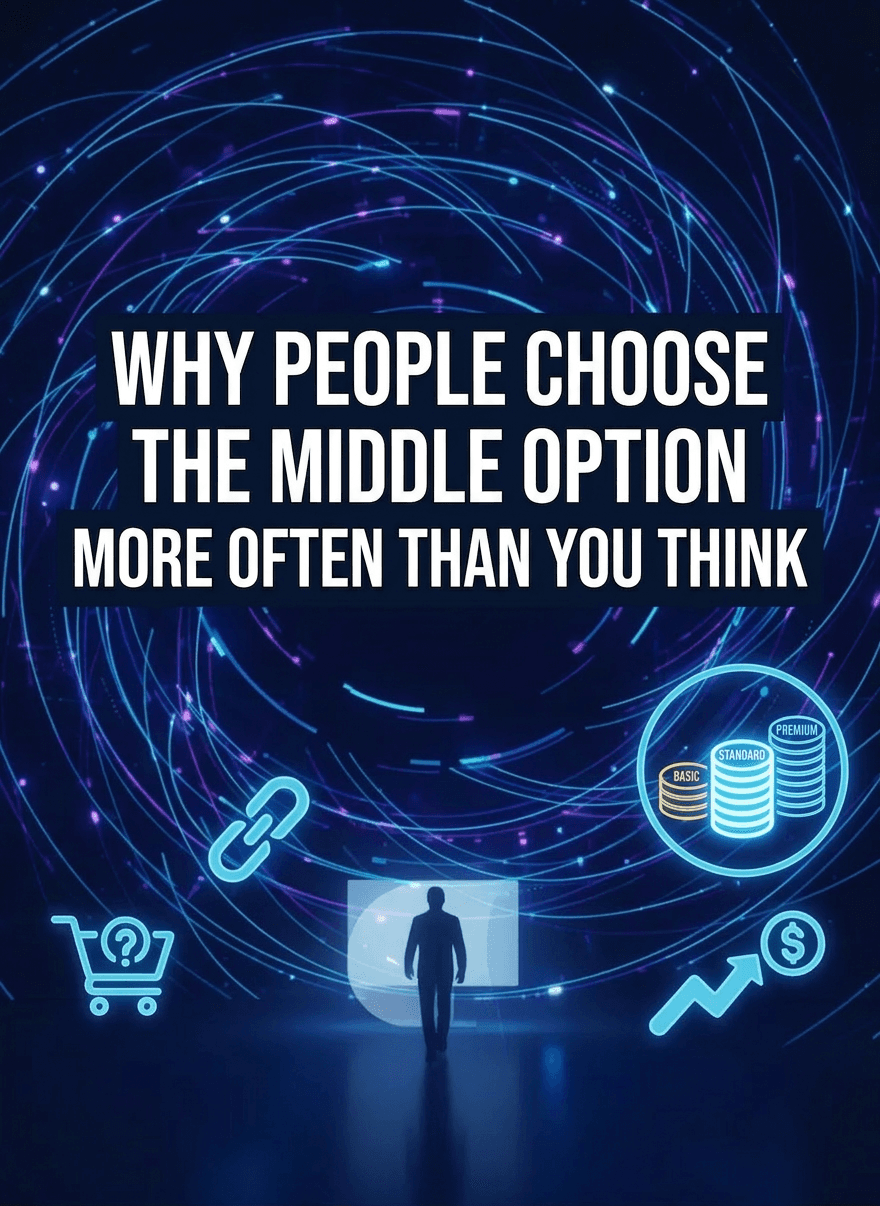
When visitors see three pricing tiers, they frequently select the middle plan.
The lowest plan may feel too limited.
The highest plan may feel too expensive.
The middle option feels balanced.
The Comfort of the Middle Choice
Humans naturally avoid extremes when making decisions.
Extreme options create uncertainty.
The cheapest option may feel risky.
The most expensive option may feel unnecessary.
The middle option feels safer.
It suggests a balance between cost and value.
Because of this, many pricing pages intentionally position the middle plan as the recommended choice.
You can see this idea explored further in The Psychology of “Most Popular” Pricing Plans.
Anchoring Shapes Price Perception
Pricing decisions are also influenced by comparison.
The first price someone sees often becomes the reference point for evaluating other options.
This psychological effect is known as anchoring.
For example, if a visitor sees a high-priced plan first, lower-priced options may feel more reasonable.
But if the first price appears low, other plans may suddenly feel expensive.
This concept is explored further in The Anchoring Effect: Why the First Price Your Customer Sees Matters.
Anchoring shapes how visitors interpret value.
Structuring Pricing Pages for Better Decisions
High-performing pricing pages make comparisons simple.
Clear feature differences.
Logical tier progression.
Visual emphasis on recommended plans.
These elements reduce the effort required to evaluate options.
When pricing feels easy to understand, visitors feel more comfortable making a decision.
And when decisions feel comfortable, conversions improve.