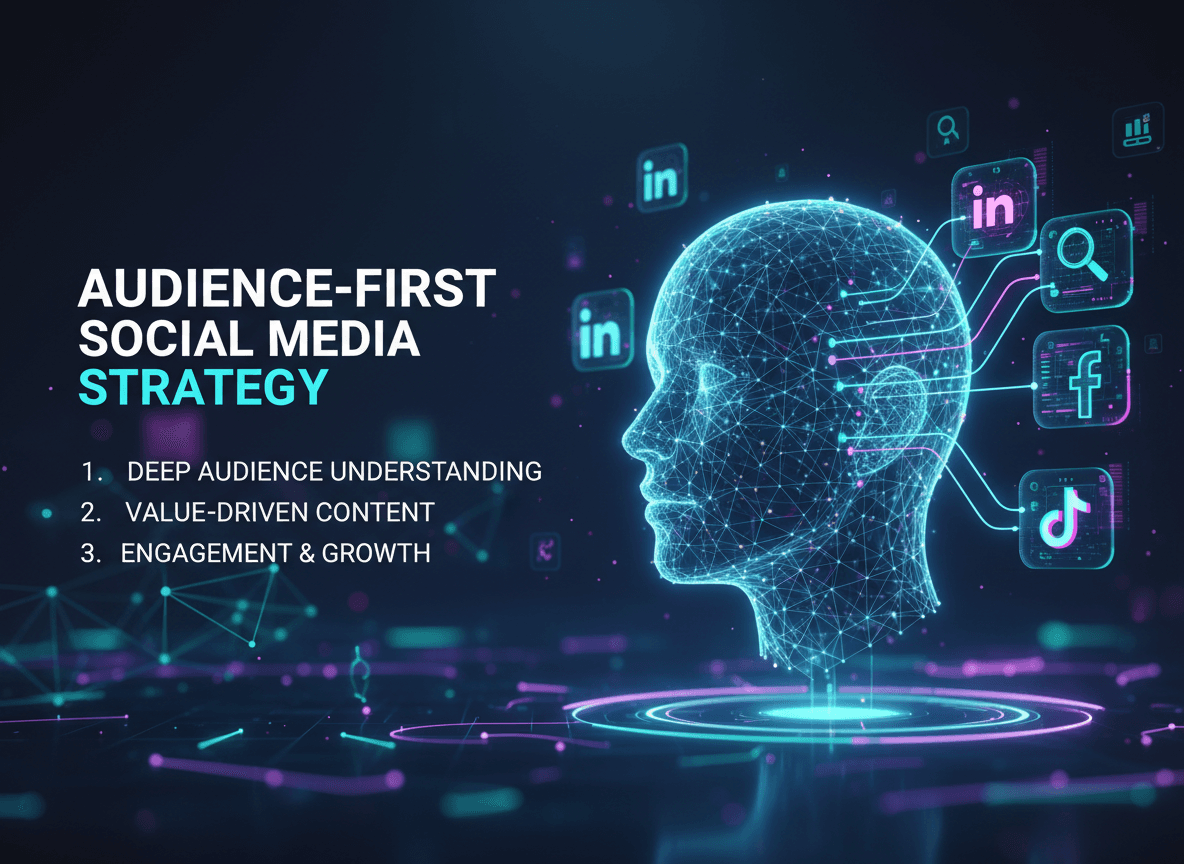
Audience-First Social Media Strategy That Converts (2026)
Most businesses build social media around themselves.
Their updates. Their offers. They win.
Then they wonder why engagement doesn’t translate into revenue.
In 2026, social media isn’t a visibility game.
It’s a conversion system.
If you’ve read:
Local SEO in 2026: How SMBs Win in 5 Steps
How AI Is Transforming Digital Marketing in 2026
Data-Driven Content Strategy: Beyond Vanity Metrics
PPC in 2026: Advanced Techniques to Maximize ROI
The ROI of Paid Social: How to Justify Budget Increases
You already know the pattern.
Structure wins.
Social is no different.
Here’s what an audience-first strategy actually looks like.
1. Start With Buyer Psychology, Not Content Ideas
Most content calendars are built around:
“What should we post this week?”
Wrong question.
The right question:
“What belief is preventing our ideal buyer from converting?”
Audience-first strategy maps content to:
Pain points
Objections
Desired outcomes
Risk perception
Purchase triggers
If your social posts don’t move someone closer to a buying decision, they’re entertainment.
Not strategy.
This mirrors the same revenue-first framework outlined in Data-Driven Content Strategy: Beyond Vanity Metrics — content must connect to pipeline movement.
Otherwise it’s noise.
2. Segment by Awareness Level
Not all followers are equal.
Some are curious. Some are frustrated. Some are comparing. Some are ready.
Audience-first content speaks to all four intentionally:
Unaware
Industry myths
Pattern interrupts
Cost-of-inaction framing
Problem Aware
Diagnostic breakdowns
Mistake analysis
“Why this isn’t working” content
Solution Aware
Case studies
Process transparency
Comparison posts
Ready to Buy
Testimonials
Direct offers
Clear CTAs
If every post tries to do everything, none of them convert.
Segmentation sharpens messaging.
Sharpened messaging increases conversion probability.
3. Treat Your Profile Like a Landing Page
In PPC in 2026: Advanced Techniques to Maximize ROI, we talked about conversion rate as the multiplier.
Social is no different.
Your profile should immediately communicate:
Who this is for
What problem you solve
Why you’re credible
What to do next
Pinned posts should reinforce positioning.
Bio should clarify the outcome.
Link should drive to one primary conversion action.
Confusion kills conversion.
Clarity compounds it.
4. Use Data to Refine, Not Guess
Audience-first doesn’t mean intuition-first.
Look at:
Saves (signals depth)
Shares (signals resonance)
Comments (signals emotion)
Click-through rate (signals intent)
DMs (signals readiness)
If posts about pricing transparency outperform motivational content, that’s not random.
That’s insight.
The same discipline applied in The ROI of Paid Social: How to Justify Budget Increases applies here.
Measure what predicts revenue — not what flatters the ego.
5. Integrate Organic and Paid
Organic builds trust. Paid scales attention.
High-performing organic posts should become ads.
High-performing ads should become organic thought leadership.
When organic and paid operate separately, growth stalls.
When they inform each other, acquisition costs drop.
This is the same integration principle covered in Local SEO in 2026: How SMBs Win in 5 Steps — disconnected marketing feels busy. Integrated marketing compounds.
Social media should plug into:
Traffic → Intent → Conversion → Follow-up → Retention.
Without follow-up systems (email, retargeting, CRM), social attention evaporates.
6. Make Clear Offers
Many brands avoid selling directly.
They over-educate. They “soft pitch.” They hope.
But if you’ve:
Diagnosed the problem
Explained the stakes
Built authority
Established trust
Then offering the solution isn’t aggressive.
It’s logical.
Audience-first doesn’t mean passive.
It means aligned.
Clear problem. Clear solution. Clear next step.
Conversion is clarity applied consistently.
7. Build Authority Through Depth
In How AI Is Transforming Digital Marketing in 2026, we covered how average content is now worthless.
AI makes volume easy.
Authority comes from:
Strong positioning
Specific frameworks
Original insight
Clear opinions
Consistent messaging
If your content could apply to anyone, it resonates with no one.
Audience-first strategy requires specificity.
Specificity builds trust. Trust lowers friction. Lower friction increases conversion.
The Real Shift
Social media used to be about reach.
Now it’s about precision.
Precision in:
Messaging
Audience segmentation
Funnel alignment
Measurement
Offer timing
The businesses winning in 2026 aren’t the loudest.
They’re the most aligned.
Aligned messaging. Aligned systems. Aligned numbers.
Everything ties back to revenue.
Just like every other channel.
Final Thought
An audience-first social media strategy isn’t about posting more.
It’s about the engineering movement.
Movement from:
Attention → Trust → Decision → Revenue.
If your social strategy isn’t connected to conversion architecture and revenue math, it’s decoration.
And decoration doesn’t scale.
Structure does.