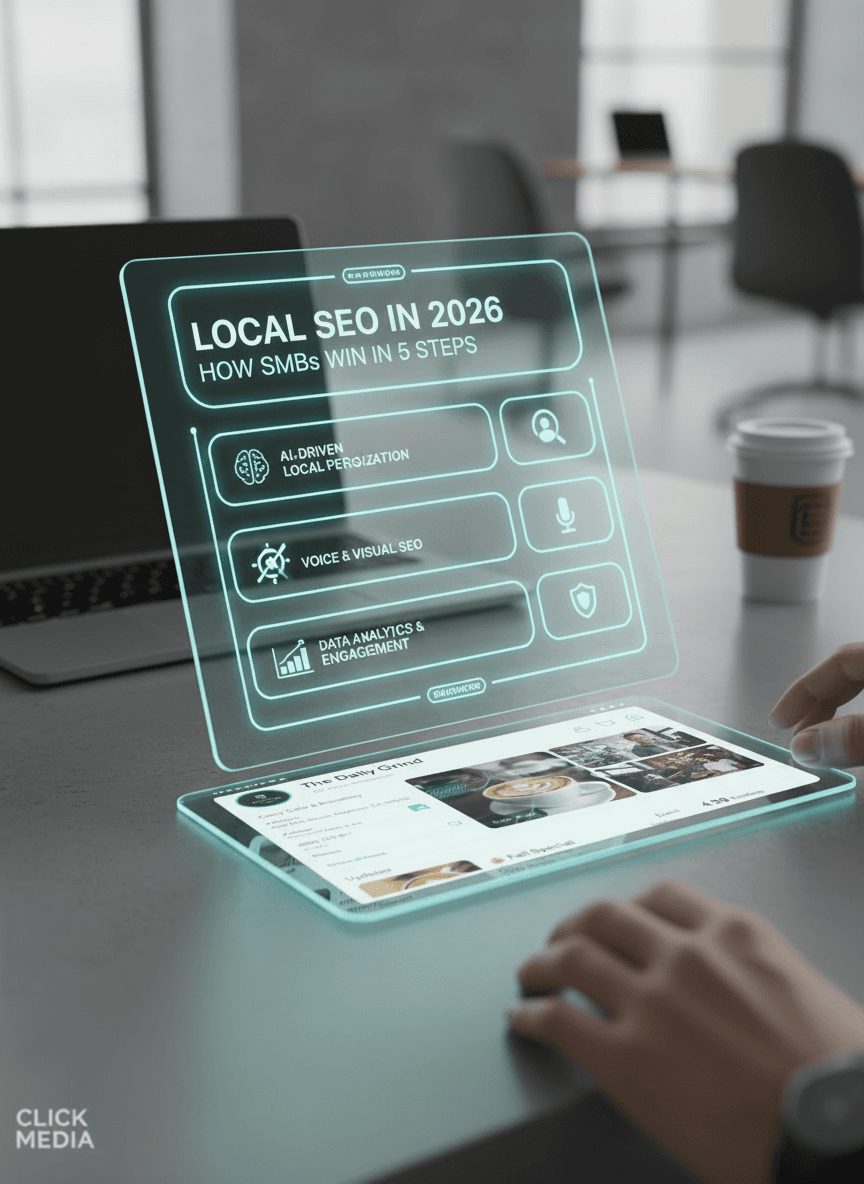
Local SEO in 2026: How SMBs Win in 5 Steps
Most small businesses think local SEO means “ranking on Google.”
It doesn’t.
It means owning local intent.
In 2026, visibility isn’t the advantage. Structure is.
Google is smarter. AI summaries are filtering results. Ads are more competitive. Local packs are tighter. If your presence isn’t engineered correctly, you’re invisible — even if you technically “exist” online.
Local SEO today isn’t about tricks.
It’s about building a predictable acquisition system.
If you haven’t read Building a Modern Digital Marketing Strategy for 2026, start there. Local SEO only works when it’s connected to revenue math and conversion structure. Otherwise, it’s just an activity.
Here’s how SMBs actually win.
1. Start With Revenue Math — Not Rankings
Ranking #1 means nothing if it doesn’t produce profitable customers.
Before optimizing anything, define:
What’s a new local client worth?
How many do you need monthly?
What’s your close rate from inbound calls/forms?
What’s your acceptable cost per acquisition?
Now reverse engineer:
Revenue goal → required clients → required leads → required local traffic.
This changes everything.
Instead of “we need more traffic,” it becomes: “We need 40 qualified local visits per week from high-intent searches.”
Local SEO without revenue math is just ego.
2. Optimize for Intent, Not Volume
In 2026, Google understands context better than ever.
You don’t need more keywords. You need the right intent.
High-intent local searches look like:
“emergency plumber near me”
“commercial HVAC repair Dallas”
“best divorce attorney free consultation”
“same day garage door repair”
Notice the pattern?
Urgency. Specificity. Transactional intent.
Your local SEO strategy should prioritize:
Service-specific pages (not one generic services page)
Location-specific landing pages (when relevant and legitimate)
Clear conversion paths on every page
Structured internal linking
If someone searches with intent and lands on a vague page, you lose.
Precision wins.
3. Your Google Business Profile Is a Conversion Asset
Most SMBs treat their Google Business Profile (GBP) like a listing.
It’s not.
It’s a sales page inside Google’s ecosystem.
In 2026, winning businesses:
Post weekly updates
Upload original photos consistently
Actively request and respond to reviews
Use services/products sections strategically
Answer FAQs directly in the profile
Monitor and optimize for calls, not just views
Reviews aren’t social proof anymore.
They’re algorithm fuel.
But here’s what most miss:
If your profile generates clicks and your website doesn’t convert, you still lose.
Local SEO and conversion optimization must work together. That’s part of a larger integrated system — the same principle outlined in Building a Modern Digital Marketing Strategy for 2026.
Traffic → Intent → Conversion → Follow-up → Retention.
Local search is just the entry point.
4. Authority Is Built Off-Site
In competitive local markets, on-page optimization is table stakes.
Authority is the differentiation.
That means:
Local back links from relevant businesses
Mentions in local publications
Chamber/association citations
Sponsorship links
Structured directory consistency (quality over quantity)
Digital PR tied to your city/region
AI-driven search models weigh entity authority more heavily now.
If your business only exists on your own website, you’re weak.
Local SEO in 2026 is about building a recognized local entity — not stuffing city names into headers.
5. Conversion Is the Multiplier
Most SMBs try to rank higher before fixing their site.
That’s backwards.
If your site converts at 3% and you double traffic, you double costs and effort.
If you increase conversion to 6%, you double revenue from the same traffic.
Local SEO amplifies what’s already there.
Winning local websites in 2026 have:
Clear positioning above the fold
Immediate trust signals (reviews, badges, proof)
Simple CTAs
Fast load times
Click-to-call functionality
Minimal friction forms
Location clarity
This is where most revenue is leaking.
It’s rarely a traffic problem. It’s a structural problem.
The Real Shift in Local SEO
Local SEO used to be about ranking.
Now it’s about predictability.
Predictable visibility. Predictable lead flow. Predictable acquisition cost.
The SMBs that win treat local SEO as one part of a larger system — integrated with paid ads, email follow-up, re-targeting, and analytics.
Disconnected efforts feel busy.
Integrated systems compound.
If your local strategy isn’t tied to revenue math, conversion data, and retention, it’s incomplete.
Final Thought
In 2026, local SEO isn’t about gaming Google.
It’s about engineering trust.
Trust in search. Trust on your site. Trust in your brand. Trust in your numbers.
The businesses that win locally won’t be the loudest.
They’ll be the most structured.
And structure scales.