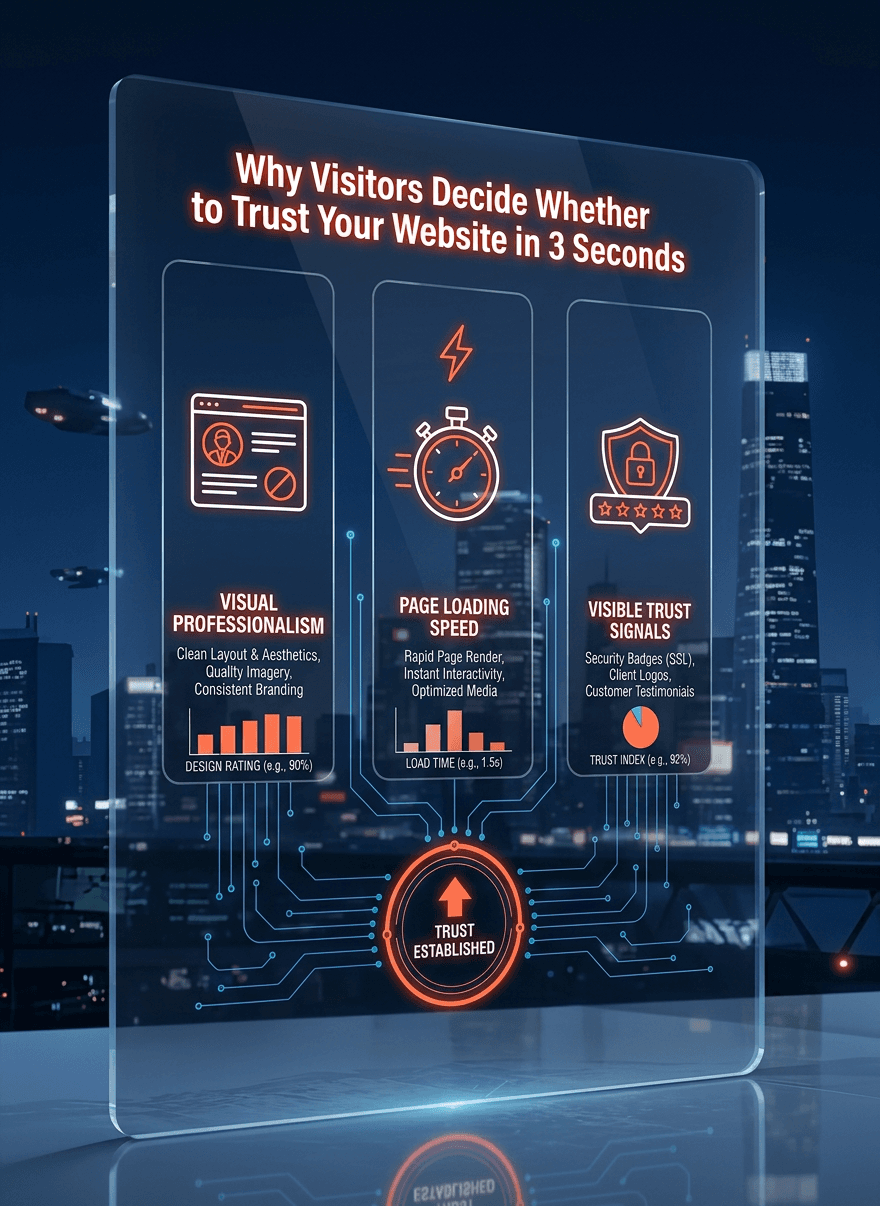
Why Visitors Decide Whether to Trust Your Website in 3 Seconds
Trust Happens Faster Than People Think
Most people assume trust develops slowly. But online, it happens almost instantly.
When visitors land on your website, they form an impression of your business within seconds. Not thoughtfully — but reflexively.
They begin scanning for signals:
Does the website look professional?
Is the message clear?
Does this company seem legitimate?
These signals determine whether someone continues exploring your site or quietly leaves.
This is why first impressions play such an important role in conversion performance.
Page Speed Shapes First Impressions
A slow website can ruin that first impression immediately.
If a page doesn’t load quickly, visitors often interpret it as a sign that something isn’t right. Even small delays can disrupt a visitor’s momentum when they’re making a decision.
We explore this further in “The Role of Page Speed in Conversion Psychology,” where we explain how even tiny delays can derail conversions.
Clarity Builds Immediate Confidence
When someone lands on your site, they aren’t trying to decode complex messaging.
They’re trying to answer three simple questions:
What do you do?
Who is it for?
Why should they trust you?
If those answers aren’t clear within seconds, uncertainty rises.
And when uncertainty increases, people become cautious.
The Importance of Visual Hierarchy
This is why visual hierarchy is critical in high-converting websites.
Strong design helps visitors quickly understand:
where to look
what matters most
what to do next
You can explore this concept further in “The Hidden Role of Visual Hierarchy in High-Converting Websites.”
Trust Is Built in Layers
Trust rarely comes from a single element.
Instead, it develops through a series of reinforcing signals, such as:
a clear headline
recognizable client logos
testimonials
a simple explanation of your process
Each of these signals strengthens a visitor’s confidence.
This concept is known as trust stacking, discussed further in “Trust Stacking: The Hidden Multiplier Behind Conversions.”
Why These Signals Matter
Even strong marketing campaigns will struggle to convert if these trust signals are missing.
But when they’re present, decision-making becomes much easier for your visitors.
And easier decisions lead to more conversions.